Urban Policy Simulation
Agent-Based & Statistical Urban Dynamics Modeling Platform
Why this system needed to exist
Urban interventions are high-stakes and irreversible. Enacting a new zoning ordinance or routing a transit line can create gentrification spirals or transit deserts that take decades to reverse. Traditional city models are often static spreadsheets that fail to capture the emergent behavior of thousands of autonomous citizens.
How the solution was designed
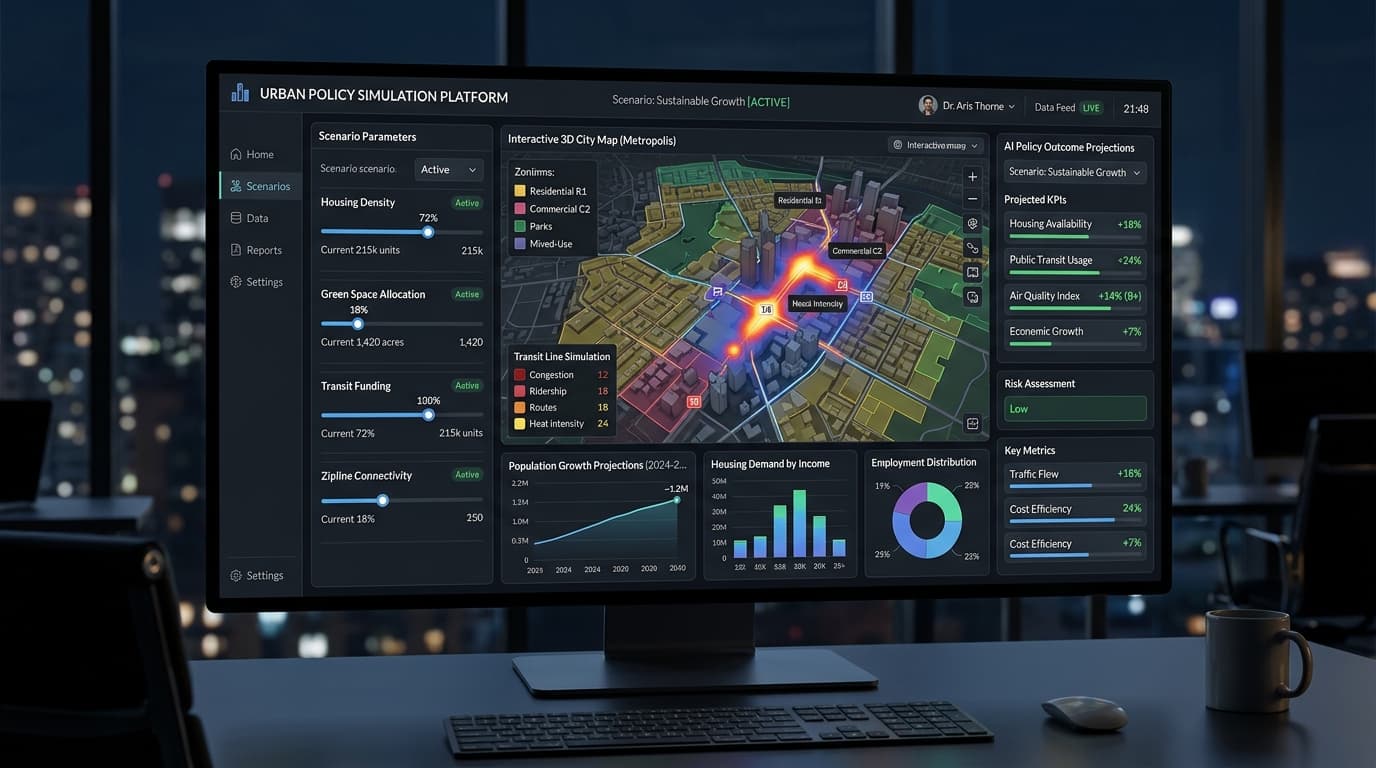
The platform combines agent-based microsimulation (where synthetic residents make daily housing, transit, and economic choices) with statistical system-dynamics models. An AI service layer generates realistic scenario variations and translates complex simulation telemetry into actionable policy takeaways.
Implemented Features & Capabilities
Component Architecture
Agent-based discrete event engine calculating emergent citizen dynamics across grid cells and transit networks.
Calibrates synthetic agent demographics and synthesizes scenario reports highlighting unintended consequences.
Manages asynchronous simulation runs, parameter checkpointing, and spatial data streaming.
Map visualization deck with parameter sliders, real-time heatmaps, and side-by-side scenario comparisons.